Table of Contents
ToggleJohn Deere Engine Identification Guide: Which Engine Is in My Tractor?
A UK parts supplier's complete reference. Covers serial number decoding, PowerTech families, cross-reference tables, and which parts are model-specific.
John Deere tractors use engines identified by a model number and a serial number, both stamped on a data plate fixed to the engine block. The model number tells you the cylinder count and displacement. The serial number tells you the factory of origin, the emissions tier, and whether the engine belongs to the older 300 series or the newer PowerTech family. Getting these two numbers right is the single most important step when ordering engine parts, because John Deere engines that share the same displacement (a 4045 in the 300 series and a 4045 in the PowerTech range, for example) use different blocks, cylinder heads, pistons, and fuel injection systems. The parts do not interchange.
This guide covers where to find the engine data plate, how to decode the model and serial numbers, the differences between John Deere's engine families, and a tractor-to-engine cross-reference table so you can confirm which engine sits in your machine. We supply engine parts for every John Deere tractor series from the classic 10 and 20 series through to the current 5R, 6M, 6R, 7R, 8R and 9R range.
1 Where to find the engine serial number on a John Deere tractor
The engine serial number plate sits on the left-hand side of the cylinder block or on top of the valve cover, depending on the engine model. Neither location requires panel removal.
On the cylinder block (most common): Look at the left side of the engine when facing the tractor from the front. The data plate is a rectangular metal tag, roughly 75mm by 50mm, riveted or screwed to the block surface. On 300 series engines it sits midway up the block, close to the fuel injection pump. On PowerTech engines it is typically lower, near the front cover on the left side.
On the valve cover: Some PowerTech engines carry a second identification label on the valve cover itself. This is a printed sticker rather than a stamped plate. It reads "PowerTech" in large text with the model number below. A legible sticker gives you the engine family at a glance. Stickers wear off after 10+ years of outdoor work, so if yours is gone, fall back to the stamped plate on the block.
The data plate lists five pieces of information: the engine serial number, the number of cylinders, the engine displacement in litres or cubic inches, the fuel type, and the aspiration method (naturally aspirated, turbocharged, or turbocharged and aftercooled). Write down the full serial number before calling or ordering parts. A photograph of the plate is even better, because worn characters can be misread over the phone.
2 How to decode a John Deere engine model number
The John Deere engine model number is a four-digit code. The first digit is the cylinder count. The remaining three digits are the displacement in cubic inches per cylinder.
| Model number | Cylinders | Displacement | Litres |
|---|---|---|---|
| 3029 | 3 | 29 cubic inches per cylinder (179 total) | 2.9L |
| 4045 | 4 | 45 cubic inches per cylinder (276 total) | 4.5L |
| 6068 | 6 | 68 cubic inches per cylinder (414 total) | 6.8L |
| 6081 | 6 | 81 cubic inches per cylinder (466 total) | 8.1L |
| 6105 | 6 | 105 cubic inches per cylinder (531 total) | 10.5L |
| 6125 | 6 | 125 cubic inches per cylinder (619 total) | 12.5L |
The same four-digit model number appears across different engine families. A 4045 in the 300 series is a completely different engine from a 4045 in the PowerTech range. The block, head, crankshaft, pistons, fuel injection pump, and water pump are all different. Ordering a "4045 cylinder head" without specifying the engine family results in the wrong part arriving.
Classic 300 series model numbers
The classic engines use the same four-digit format. Common model numbers include:
- 3-cylinder: 3152 (2.5L), 3164 (2.7L), 3179 (2.9L), 3029 (2.9L)
- 4-cylinder: 4202 (3.3L), 4219 (3.6L), 4239 (3.9L), 4276 (4.5L), 4045 (4.5L)
- 6-cylinder: 6303 (5.0L), 6329 (5.4L), 6359 (5.9L), 6414 (6.8L), 6068 (6.8L)
Letters after the model number
After the four-digit code, John Deere adds letter suffixes that identify the engine family and configuration. For example, a 6068HF485 breaks down as: 6068 (6-cylinder, 6.8L displacement), H (turbocharged air-to-air aftercooled), F (a specific configuration code), and 485 (the option or variant number). For parts ordering purposes, the full alphanumeric designation matters. Write it all down.
3 How to decode a John Deere engine serial number
The engine serial number is a 13-character code. Each section carries specific information.
| Position | What it tells you | Example |
|---|---|---|
| Characters 1-2 | Factory of manufacture | TO = Dubuque, Iowa; CD = Saran, France; PE = Torreon, Mexico |
| Character 3 | Number of cylinders | 6 |
| Characters 4-6 | Engine displacement (cubic inches per cylinder) | 068 = 6.8L |
| Character 7 | Emissions tier or aspiration code | See table below |
| Characters 8-13 | Sequential production number | 544668 |
Emissions and aspiration codes
Older engines (pre-emissions regulation) use aspiration codes in position 7:
| Code | Meaning |
|---|---|
| D | Naturally aspirated |
| T | Turbocharged |
| A | Turbocharged, air-to-coolant aftercooled |
| H | Turbocharged, air-to-air aftercooled |
Newer engines (emissions-regulated) use tier codes instead:
| Code | Emissions standard |
|---|---|
| B | Non-certified |
| C, E, F | Tier 1 / Stage I |
| G, J, K | Tier 2 / Stage II |
| L, M, N, P | Tier 3 / Stage IIIA |
| R | Interim Tier 4 / Stage IIIB |
| U | Final Tier 4 / Stage IV / Stage V |
4 John Deere engine families explained
John Deere tractor engines fall into two broad eras: the classic 300/400 series engines built from the 1960s through the 1990s, and the PowerTech family introduced from the mid-1990s onwards. Within the PowerTech family, there are several sub-families distinguished by their emissions technology.
300 series (pre-PowerTech)
The 300 series is John Deere's longest-running engine platform. These engines use mechanical fuel injection (inline or rotary injection pumps), cast-iron blocks, and wet-sleeve cylinder liners. They are straightforward to rebuild and parts availability remains strong.
300 series engines power tractors from the 10 series (1010, 2010, 3010, 4010), 20 series (1020, 2020, 3020, 4020), 30 series (2030, 4030, 4230, 4430, 4630), and 40/50 series (2040, 2140, 3040, 3140). If your tractor was built before 1992, it almost certainly has a 300 series engine.
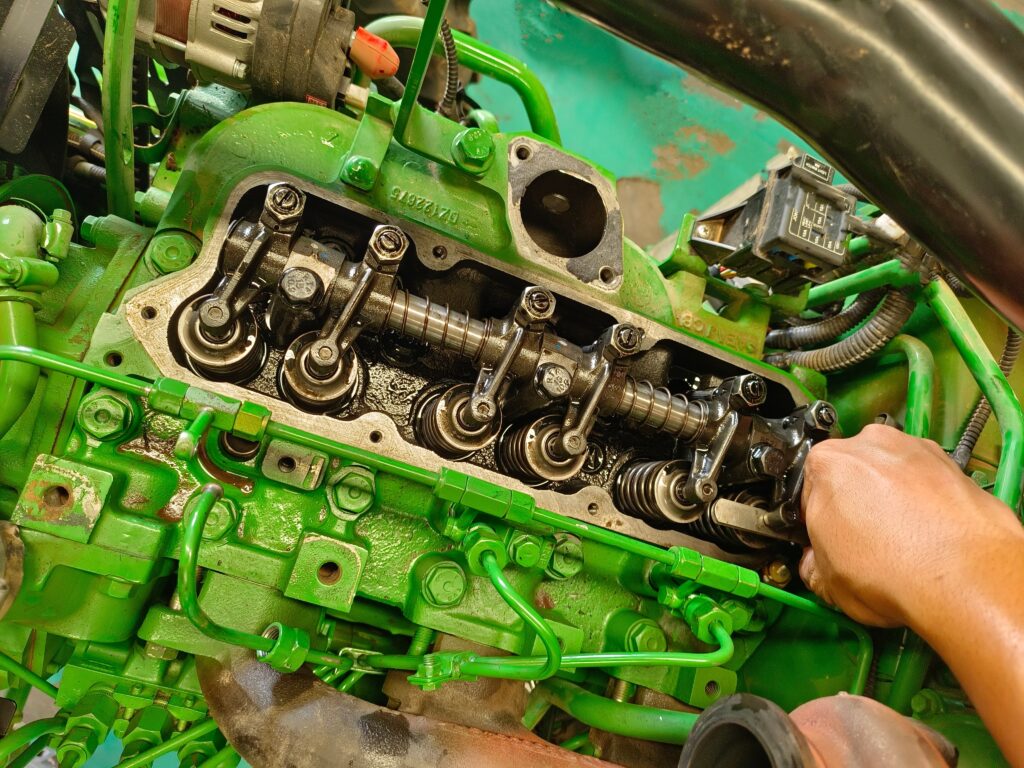
Visual identification: 300 series engines have valve cover bolt holes spaced around the perimeter of the cover. PowerTech engines have them running down the centre line. This is the fastest way to tell the two families apart without checking the data plate.
400 series
The 400 series covers larger displacement engines: the 6466 (7.6L) in the 4040, 4240, 4440 and 4640 tractors, and the 6076 (7.6L turbo) in the later 4055, 4255, and 4455. These are six-cylinder engines with higher output than their 300 series equivalents.
PowerTech (from mid-1990s)
PowerTech is John Deere's electronic engine platform. The core models are the 3029 (2.9L, 3-cylinder), 4045 (4.5L, 4-cylinder), and 6068 (6.8L, 6-cylinder). PowerTech engines introduced electronic fuel injection (high-pressure common rail from Tier 3 onwards), four-valve cylinder heads, and electronic engine management.
PowerTech engines are identified by the "PowerTech" sticker on the valve cover and by the centre-line valve cover bolt pattern. The front engine mounts use an L-shaped bolt pattern with three capscrews facing outward on each side, which differs from the 300 series mounting.
PowerTech Plus
PowerTech Plus engines added cooled exhaust gas recirculation (EGR) and a diesel particulate filter (DPF) to meet Tier 3/Stage IIIA emissions. These engines appear in 6030 series tractors (6330, 6430, 6530, 6630, 6830, 6930) and early 6R models.
PowerTech PSS
PowerTech PSS (Performance Series SCR) engines combine a diesel oxidation catalyst (DOC), a DPF, and selective catalytic reduction (SCR) using AdBlue/DEF fluid. This is the Final Tier 4/Stage IV platform, fitted to current 6R, 7R, and 8R series tractors. The 4045 PSS produces up to 130hp and the 6068 PSS produces up to 250hp in tractor applications.
PowerTech PVS
PowerTech PVS engines add a variable geometry turbocharger (VGT) to the PSS platform. These appear in the higher-output 6R models (6R 175, 6R 195, 6R 215) and deliver faster throttle response and improved fuel efficiency at partial load.
PowerTech EWL
PowerTech EWL engines use exhaust gas recirculation and a diesel oxidation catalyst without a DPF. The EWL platform appears in smaller tractors (5E and 5M series) where the lower power output allows simpler aftertreatment. The 3029 EWL in the 5075E produces 55kW (75hp) at 2,100rpm and requires no DEF fluid, no DPF, and no regeneration cycles.
5 Tractor model to engine cross-reference table
The table below maps common John Deere tractor models to their engine type. Use this to confirm your engine before ordering parts.
Classic tractors (300/400 series engines)
| Tractor model | Engine model | Cylinders | Displacement | Notes |
|---|---|---|---|---|
| 1020 | 3152 | 3 | 2.5L (152ci) | Naturally aspirated |
| 1030, 1130 | 3179 | 3 | 2.9L (179ci) | Naturally aspirated |
| 2020 | 4202 or 4219 | 4 | 3.3L or 3.6L | Varies by year |
| 2030 | 4219 | 4 | 3.6L (219ci) | Naturally aspirated |
| 2040 | 3179 | 3 | 2.9L (179ci) | Naturally aspirated |
| 2140 | 4239 | 4 | 3.9L (239ci) | Turbocharged on later models |
| 3020 | 4270 | 4 | 4.4L (270ci) | Naturally aspirated |
| 3030, 3130 | 4239 | 4 | 3.9L (239ci) | Naturally aspirated |
| 3040, 3140 | 4239 | 4 | 3.9L (239ci) | Turbo available |
| 4020 | 6404 | 6 | 6.6L (404ci) | Naturally aspirated |
| 4030 | 6329 | 6 | 5.4L (329ci) | Turbocharged |
| 4040, 4240 | 6466 | 6 | 7.6L (466ci) | Naturally aspirated (4040), turbo (4240) |
| 4430 | 6414 | 6 | 6.8L (414ci) | Turbocharged and aftercooled |
| 4440 | 6466 | 6 | 7.6L (466ci) | Turbocharged |
| 4630 | 6404 | 6 | 6.6L (404ci) | Turbocharged and aftercooled |
Modern tractors (PowerTech family engines)
| Tractor series | Engine model | Cylinders | Displacement | Engine family |
|---|---|---|---|---|
| 5045E, 5050E, 5055E | 3029 | 3 | 2.9L | PowerTech EWL |
| 5075E, 5075M | 3029 | 3 | 2.9L | PowerTech EWR |
| 5090M, 5100M, 5115M | 4045 | 4 | 4.5L | PowerTech EWL |
| 5R (5100R, 5115R, 5125R) | 4045 | 4 | 4.5L | PowerTech PVS |
| 6110M, 6120M, 6130M | 4045 | 4 | 4.5L | PowerTech PSS |
| 6140M, 6150M, 6155M | 4045 | 4 | 4.5L | PowerTech PSS |
| 6195M | 6068 | 6 | 6.8L | PowerTech PSS |
| 6R 110, 6R 120, 6R 130 | 4045 | 4 | 4.5L | PowerTech PSS |
| 6R 140, 6R 150, 6R 155 | 6068 | 6 | 6.8L | PowerTech PSS |
| 6R 175, 6R 195, 6R 215 | 6068 | 6 | 6.8L | PowerTech PVS |
| 6R 250 | 6068 | 6 | 6.8L | PowerTech PVS |
| 7R 270, 7R 290, 7R 310 | 6068 | 6 | 6.8L | PowerTech PSS |
| 7R 330, 7R 350 | 6068 | 6 | 6.8L | PowerTech PSS |
| 8R 280, 8R 310, 8R 340 | 6068 | 6 | 6.8L | PowerTech PSS |
| 8R 370, 8R 410 | 6090 | 6 | 9.0L | PowerTech PSS |
| 9R 390, 9R 440, 9R 490 | 6135 | 6 | 13.5L | PowerTech PSS |
| 9R 540, 9R 590, 9R 640 | 6135 | 6 | 13.5L | PowerTech PSS |
Tractor not in the table? Ring us on 01777 838250 with both your tractor PIN and engine serial number. We will match your numbers to the right engine and confirm which parts you need.
6 Which engine parts are model-specific and which are shared
Some engine parts are unique to a specific engine model and family combination. Others are shared across multiple engines within the same family. Knowing the difference saves time when ordering.
Always model-specific
These parts differ between engine models and between 300 series and PowerTech versions of the same model:
- Cylinder head: Different casting, valve count (2-valve on 300 series, 4-valve on PowerTech), and combustion chamber shape
- Pistons: Different crown profile, compression ratio, and ring configuration
- Fuel injection pump: Mechanical (inline or rotary) on 300 series, electronic common rail on PowerTech Tier 3+
- Crankshaft: Different counterweight arrangement and rear seal configuration
- Front cover and timing gear housing: Different mounting points and oil passage layout
- Water pump: Different impeller diameter, housing shape, and mounting pattern
Often shared within a family
These parts are frequently (but not always) shared across engines in the same family and displacement group:
- Oil filters and fuel filters: Many PowerTech 4045 and 6068 engines share the same filter housings and element sizes
- Belts: Engines within the same displacement group often share belt lengths
- Thermostat housings: Common across models within the same family
- Gasket sets: Available as family-specific kits (e.g., "PowerTech 4045 overhaul gasket set")
The safest approach
Provide your full engine serial number when ordering any engine part. Shared parts do vary between production runs, so the serial number is the only way to confirm the exact build specification. Give us the number and we match it to the right component first time.
7 How to use your engine ID to order the right parts from Nick Young
Ordering engine parts for a John Deere tractor takes three pieces of information: the tractor model, the engine model number, and the engine serial number.
- Find the engine data plate. Check the left side of the cylinder block first. If no plate is visible, check the valve cover for a printed label.
- Write down or photograph the plate. Record the full model number (all digits and letters) and the full serial number (all 13 characters). A clear photograph avoids transcription errors.
- Confirm the engine family. Use the serial number's last six digits. If the number is 150 or above, you have a PowerTech. Below 150 is a 300 series. Alternatively, check the valve cover bolt pattern: perimeter bolts indicate 300 series, centre-line bolts indicate PowerTech.
- Contact us with all three numbers. Call 01777 838250, email [email protected], or visit nytractorparts.co.uk. Give us the tractor model, engine model, and engine serial number. We will confirm the correct parts and get them dispatched, usually same day for stock items.
We hold engine parts for John Deere tractors from the 1020 through to the current 9R series. Filters, gaskets, pistons, liners, bearings, seals, injectors, pumps, and complete overhaul kits are all available. If a part is not on the shelf, we source it within 48 hours.
Ready to order engine parts?
Have your tractor model, engine model, and engine serial number to hand. Get in touch and we will identify the right parts and ship them fast.